
The pressure on real estate portfolios to demonstrate ESG credentials has never been more acute. SFDR, CSRD, GRESB, EU Taxonomy — the regulatory and reporting stack has grown faster than most organisations' ability to respond to it.
And yet, for many asset managers, the fundamental challenge is not reporting. It is data. Specifically: the right kind of data, collected at the right level of granularity, with enough integrity to withstand scrutiny from LPs, auditors, and increasingly, tenants.
The gap between reported and real
Most ESG reporting in real estate still relies on top-down estimation. Energy consumption is modelled from building class and square footage. Carbon intensity is derived from grid averages. Water and air quality figures are inferred from regional datasets or supplier declarations.
This approach is defensible — up to a point. It scales. It fits existing reporting templates. And for a portfolio of hundreds of assets, granular site-level data collection has historically been impractical.
But it creates a credibility problem. Estimated performance is not the same as measured performance. And as regulatory frameworks tighten and institutional buyers conduct more rigorous due diligence, the gap between reported and real is becoming a valuation issue.
Assets with verified, site-level environmental data are increasingly differentiated in acquisition processes, refinancing events and green bond frameworks. Assets without them are not just harder to report on — they are harder to price.
Why on-site measurement changes the equation
The shift from estimated to measured ESG performance is not purely a compliance exercise. It changes what is possible strategically.
Accountability at asset level
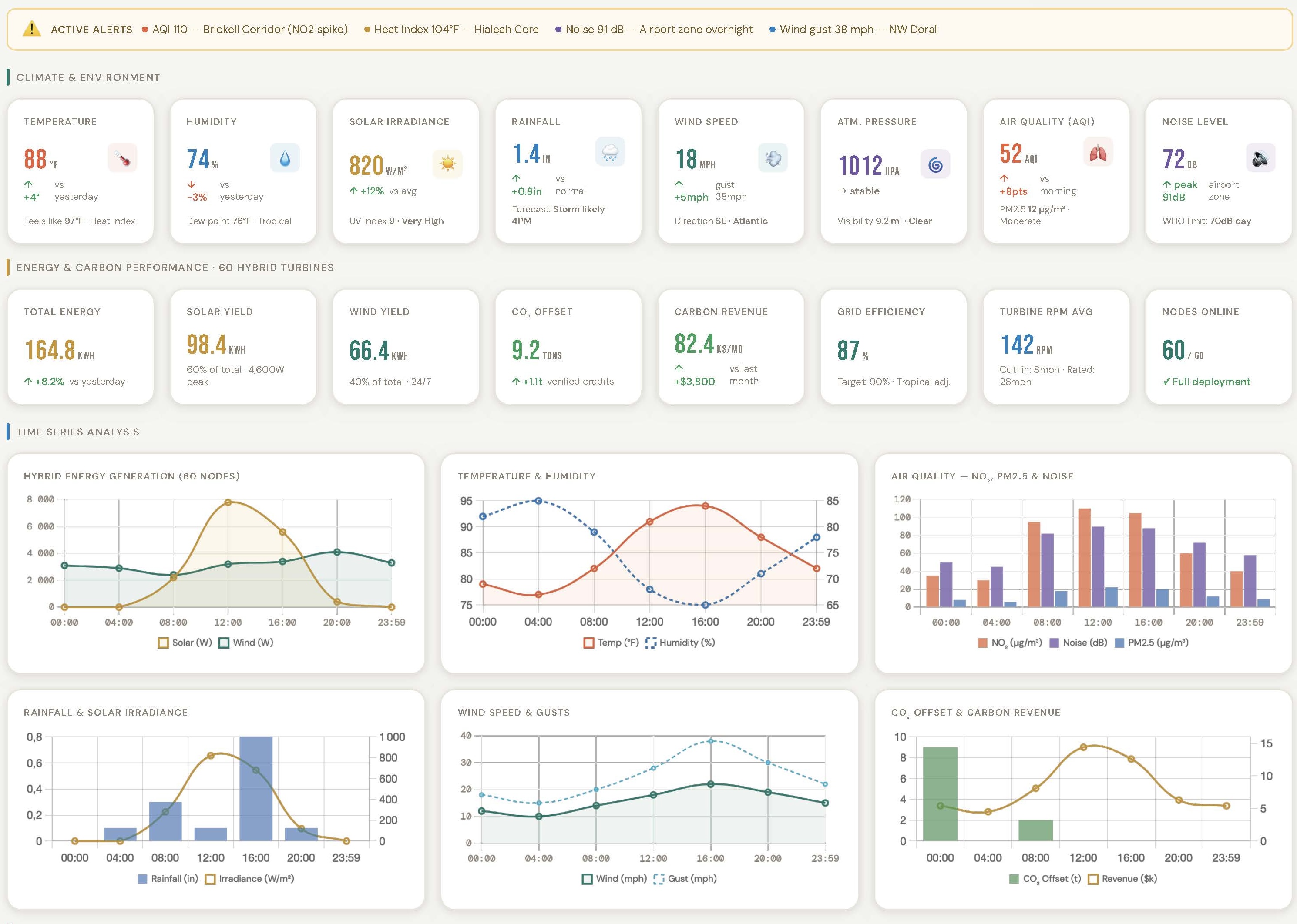
When environmental performance is measured continuously at the site — energy production, carbon intensity, air quality, microclimate conditions — the asset manager has a real-time view of what is actually happening, not what was modelled three years ago.
Tenant and occupier credibility
Corporate tenants are themselves under pressure to report Scope 3 emissions, which include their occupied premises. An asset that provides certified, auditable environmental performance data to tenants is not just easier to lease — it is a genuine differentiator in markets where sustainability credentials are a selection criterion.
Financing and certification advantages
Green finance instruments — green bonds, sustainability-linked loans, BREEAM or HQE certification — require evidence. Evidence generated from physical infrastructure on site is structurally more robust than modelled estimates.
Resilience as a measurable asset quality
On-site generation and environmental monitoring do not only produce data — they also change the operational profile of the asset. Partial energy autonomy, documented microclimate conditions and continuous air quality monitoring all contribute to a resilience argument that is increasingly relevant to institutional buyers and insurers.
Measured ESG changes the asset discussion from reporting compliance to operational performance.
What credible on-site ESG infrastructure looks like
For an asset manager building a credible ESG layer across a portfolio, the question is not whether to invest in on-site measurement — it is what that investment should produce.
The most effective approaches share three characteristics.
First, they generate continuous data, not point-in-time snapshots. Annual audits and quarterly surveys are useful baselines, but they cannot capture the variance in performance that matters for operational decisions and regulatory reporting.
Second, they produce certified outputs. Raw sensor data has limited reporting value unless it feeds a recognised certification or verification framework. Certified outputs carry weight with auditors, rating agencies and LPs in ways that self-reported data does not.
Third, they are physically embedded in the asset. Sustainability performance that is visible — literally present on the site, generating clean energy, capturing environmental data and demonstrating commitment to the built environment — communicates differently than a report.
From compliance to competitive advantage
The ESG pressure on real estate is not going away. But the asset managers who treat it purely as a compliance burden will find themselves continuously reactive — chasing reporting requirements rather than building assets that perform better and are worth more.
The shift worth making is from reporting sustainability to demonstrating it. Not through better templates, but through physical infrastructure that generates real performance, real data and real certification — at the asset level, continuously, in a form that withstands scrutiny.
That shift is now operationally achievable. The infrastructure exists. The certification frameworks exist. The financing instruments that reward it exist.
The remaining question is which assets will be positioned to benefit from the next wave of ESG-driven repricing — and which will not.