
Infrastructure has always been about assets. A power plant, a grid connection, a generation unit — each element is designed, financed and operated as a standalone component with a clearly defined output and a predictable return profile.
This model has worked for decades. It is capital-efficient, well understood and deeply embedded in how infrastructure investors think.
But it is now being challenged by a structural shift.
The value of infrastructure is no longer limited to what each asset produces individually. It increasingly depends on how assets connect, interact and generate intelligence collectively.
The limitation of isolated assets
An energy asset, taken in isolation, is inherently limited. It produces energy, generates revenue and operates within predefined parameters.
But it does not improve significantly over time. Its performance may degrade. Its output may fluctuate. Its financial profile remains relatively static.
Most importantly, it does not learn.
Each asset exists as a fixed point in space — not as part of a system that evolves. This is the fundamental limitation of traditional infrastructure thinking.
Infrastructure designed only as an asset produces output. Infrastructure designed as a network produces intelligence.
When infrastructure becomes a network
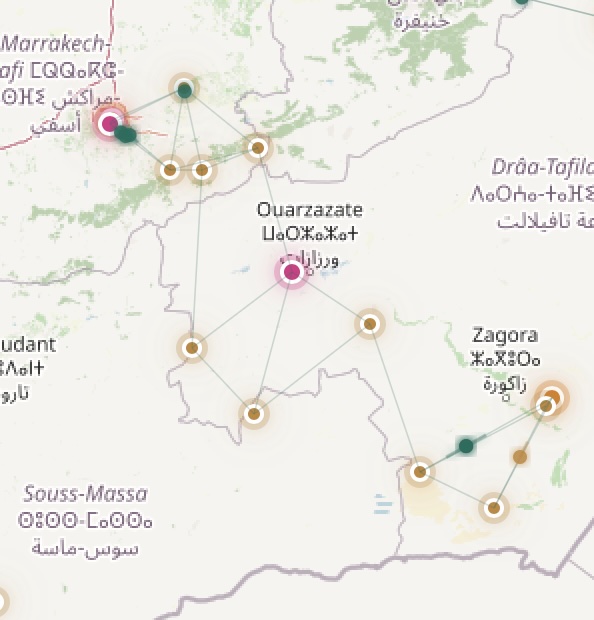
The moment infrastructure assets are connected through a shared data layer, their nature changes. They stop being isolated units. They become nodes.
Each node captures local signals: environmental conditions, operational performance, energy production dynamics and site-level variability.
But the real value does not come from the node itself. It comes from the network.
Because once multiple nodes are deployed across different locations, a new capability emerges: the ability to observe patterns across space and time.
The emergence of intelligence networks
An intelligence network is not defined by its hardware. It is defined by three properties.
Continuous data generation
Each node produces real-world data continuously. The asset does not only operate; it observes the environment in which it operates.
Aggregation at scale
Data from multiple locations is combined into a unified dataset. Local signals become a broader intelligence layer that can reveal patterns a single asset cannot detect.
Feedback loops
The system improves decisions based on accumulated data. Performance, maintenance, risk analysis and environmental insight become progressively more precise.
Once these three conditions are met, infrastructure stops being static. It becomes adaptive.
From production to learning systems
Traditional infrastructure is optimized for output. Intelligence networks are optimized for learning. This distinction is critical.
In a production model, value is created once through energy generation and then monetized repeatedly. In a learning system, value increases over time because the system becomes more accurate, more predictive and more useful.
Each additional deployment improves the entire network. Each new data point strengthens the model. The infrastructure layer becomes not only a source of energy, but a mechanism for accumulating knowledge.
A compounding asset
This creates a new type of asset embedded within infrastructure. Not physical. Not purely digital. But data-driven and compounding.
A network of distributed energy systems becomes a dataset, a modelling capability and a decision engine. Unlike physical assets, this layer does not depreciate in the same way. It improves with scale.
That is what makes the shift strategically important. The asset may be deployed for energy reasons, but the network may become valuable for intelligence reasons.
Why this matters for infrastructure investors
This shift has direct implications for capital allocation. Investing in infrastructure is no longer just about yield, stability and long-term cash flows. It is also about positioning within emerging intelligence networks.
The most valuable infrastructure assets of the next decade will not necessarily be the most efficient in isolation. They will be the ones best integrated into networks that capture real-world data, generate predictive insights and enable better decisions.
The infrastructure transition
We are moving from a world of assets to a world of systems. From isolated production to connected intelligence. From static infrastructure to adaptive networks.
The future of infrastructure is not just distributed. It is networked — and intelligent. Energy assets will continue to matter. But their true value will increasingly depend on the intelligence networks they belong to.