For years, a climate dashboard was a compliance tool. You opened it to fill an annual report, sent it to auditors, closed it. The figures were often estimated, sometimes aggregated from regional sources, rarely drawn from the site itself. They served to document — not to decide.
That era is ending. Not because reporting obligations have disappeared — they have multiplied. But because the nature of environmental data has changed. It has become continuous, localized, real-time. And continuous, localized data no longer behaves like a reporting indicator. It behaves like an operational signal.
This shift — from compliance dashboard to decision tool — is one of the most underestimated transformations in asset management and industrial operations. It changes what is possible with infrastructure, and what we are entitled to expect from it.
What has changed in the data
Yesterday's environmental data was essentially a stock figure. You measured a building's energy consumption over a year, calculated the associated carbon intensity, compared it to a sector benchmark. The process was annual, granularity was low, and the chain between measurement and decision was long.
That model had a logic when instrumenting a site was expensive, communication networks were limited, and reporting frameworks themselves asked little in the way of granularity. You worked with what you had.
Three developments have changed the equation simultaneously.
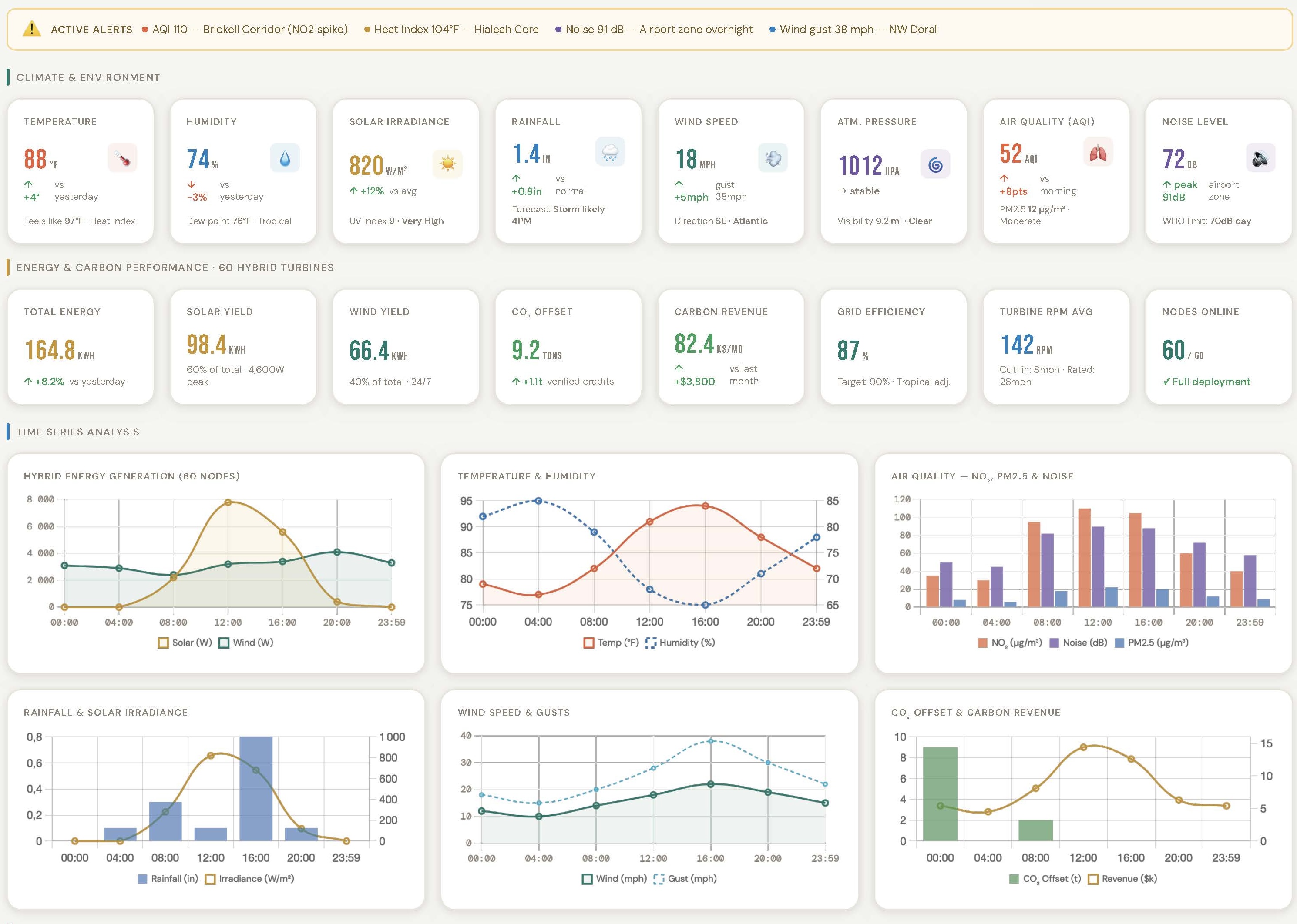
First, sensor costs have fallen. What cost several thousand euros per measurement point in the 2000s now costs a fraction of that — and produces far richer data: temperature, humidity, air quality, solar irradiance, wind speed, atmospheric pressure, real-time electricity consumption.
Second, connectivity has become ubiquitous. Data captured on an isolated site in Kenya, a Nordic port or a Parisian rooftop can be aggregated and visualized from anywhere, in seconds. Physical distance is no longer an obstacle to operational visibility.
Third, reporting frameworks have moved toward field data. CSRD, SFDR, EU Taxonomy, TCFD — these frameworks now require verifiable, traceable data, preferably measured directly on site. Regional estimates and sectoral proxies are losing credibility with auditors, rating agencies and institutional investors.
Environmental data is no longer a balance-sheet indicator. It is a continuous stream that can feed real-time operational decisions.
What this changes for asset managers
For a real estate portfolio manager or infrastructure asset manager, the shift to continuous field data opens possibilities that simply did not exist with annual estimated figures.
Real visibility into asset performance
When energy production, air quality, temperature and humidity are measured continuously on site, the manager is no longer managing an assumption about what the asset does — they are managing what the asset actually does. The difference is substantial for early anomaly detection, predictive maintenance and operational cost management.
A stronger financing argument
Green bonds, impact loans, BREEAM or HQE certifications all require evidence of environmental performance. Certified, continuous field data is structurally more robust than modelled estimates in meeting these requirements — and it opens access to financing instruments whose terms are directly tied to measured performance.
A valuation lever
Assets with certified, site-level environmental data are beginning to differentiate in transaction, refinancing and disposal processes. For institutional buyers and ESG-mandated funds, the quality of field data has become an evaluation criterion — not simply a bonus.
A communication tool toward tenants
Corporate tenants are themselves under pressure to declare their Scope 3 emissions, which include their occupied premises. An asset that provides certified, real-time environmental performance data in the format their own frameworks require is not only easier to occupy — it is a concrete leasing advantage in a market where sustainability has become a selection criterion.
What this changes for industrial operators
For an industrial operator — mining site, port, logistics warehouse, telecom infrastructure — continuous field data has an even more direct value. It does not only serve reporting: it serves to maintain operations, anticipate failures and document the real impact of an investment.
Anticipate rather than react
An operator with continuous meteorological and environmental data on their site sees difficult conditions coming before they affect operations. Strong wind approaching a port — teams can prepare. A heat peak forecast at a logistics site — energy-intensive processes can be rescheduled. Abnormal atmospheric pressure variation on an isolated site — the signal often precedes a deterioration of operating conditions.
This anticipation capacity — moving from reactive to predictive mode — is one of the most valuable operational changes that continuous field data enables. And it is directly proportional to the quality and granularity of the data captured on site.
Predictive maintenance based on real conditions
Traditional maintenance plans are calendar-based. You intervene every x weeks, regardless of the actual state of equipment. Continuous field data enables a different logic: you intervene when environmental and operational signals indicate a drift, anomaly or stress that typically precedes a failure.
For remote or hard-to-access sites — mines, offshore installations, rural telecom infrastructure — the value of this anticipation is particularly strong. Every avoided or better-planned intervention reduces logistics costs and operational downtime.
Documenting the real impact of an energy investment
When an industrial operator deploys local production infrastructure — hybrid wind and solar to reduce diesel dependency — they need to measure the real impact of that investment. How many kWh produced? How many litres of diesel displaced? What Scope 1 emissions reduction? What fuel cost savings?
Without continuous field data, these figures are estimates. With an embedded sensor layer in the infrastructure, they become measurements — auditable, certifiable and usable in ESG reports, financing applications and carbon commitments.
The data layer as a strategic asset
What is emerging is not simply a better dashboard. It is a new asset layer embedded within physical infrastructure.
A network of sites equipped with environmental and energy sensors produces, over time, something more valuable than the sum of its individual measurements. It produces a longitudinal, localized, continuous dataset — one that improves with time, reveals patterns that point-in-time data cannot surface, and feeds increasingly precise predictive models.
This is precisely the logic that distinguishes a data infrastructure from a reporting infrastructure. The former appreciates as it accumulates context. The latter remains static between disclosure exercises.
What a good operational climate dashboard must produce
Continuity. A dashboard fed by annual or quarterly data cannot support operational decisions. Data must be continuous — ideally real-time, or at minimum at a frequency sufficient to detect anomalies before they become problems.
Field grounding. Data must come from the site itself, not from regional models or distant weather stations. The operational relevance of a data point is directly proportional to its physical proximity to the site it is supposed to describe.
Certification. For data to serve ESG reporting, financing applications or carbon commitments, it must be third-party verifiable. Self-declared data loses credibility as frameworks tighten. Certified data withstands audit.
Interoperability. An operational climate dashboard is only useful if it can integrate with existing systems — ERP, CMMS, asset management systems, ESG reporting platforms. The value of field data depends on its ability to feed the workflows where decisions are made.
Scalability. Network logic applies here: a dashboard covering one site produces local visibility. A dashboard covering ten sites produces comparability. A dashboard covering a hundred sites produces intelligence — the ability to identify patterns, anomalies and opportunities that the site-by-site view does not reveal.
Field data does not replace human judgment. It gives it a foundation to stand on — and an early warning before problems become visible to the naked eye.
The shift that is underway
What is happening in asset management and industrial operations resembles what happened in other sectors when continuous data replaced point-in-time data.
In finance, the shift from daily prices to tick-by-tick data transformed how markets function. In logistics, the shift from batch tracking to real-time tracking transformed supply chain management. In industrial maintenance, the shift from calendar-based plans to IoT sensors transformed equipment management.
The same shift is now underway in the management of environment and energy on physical sites. Continuous environmental data is not yet universal — but it is becoming the standard for assets that want to remain competitive, financeable and operationally robust.
Organisations that integrate this layer today are building a durable advantage. They develop capabilities — monitoring, anticipation, certification, optimisation — that appreciate as data accumulates and frameworks tighten. Those who wait face an increasingly costly catch-up.