
Diesel has been the default answer to energy insecurity for decades. It is available almost everywhere, it starts quickly, and its logic is simple: when the grid fails or is absent, a generator fills the gap. For operators managing remote sites, exposed infrastructure or intermittent grid access, this logic still holds in millions of locations worldwide.
But default answers accumulate costs. And the costs of diesel dependency — operational, financial, environmental and reputational — have grown steadily as the alternatives have matured.
The question is no longer whether diesel can be replaced. It is why so many operators are still waiting to act.
What diesel dependency actually costs
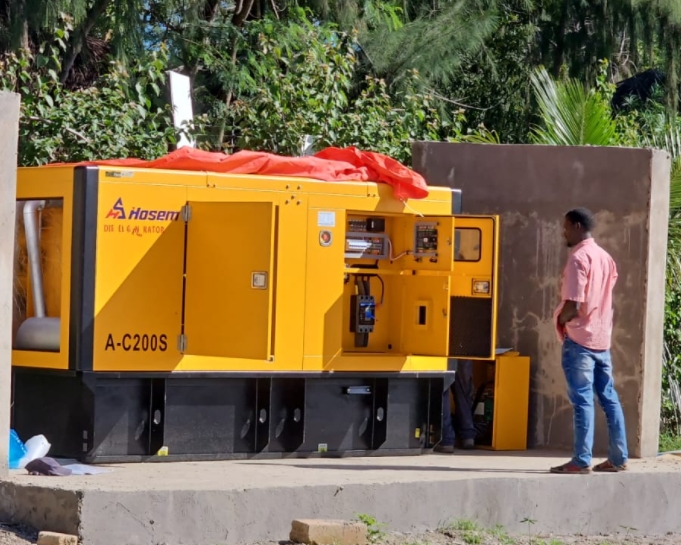
The direct cost of diesel fuel is visible on every invoice. But it represents only part of the total cost of a diesel-dependent energy model.
Fuel price volatility
Diesel prices are driven by global commodity markets over which operators have no influence. A site that runs on diesel is a site whose energy budget can shift 30 to 50 percent within a single year — with no operational change on the ground. For any asset with multi-year investment horizons, this volatility is a structural planning problem, not a short-term inconvenience.
Supply chain fragility
Fuel delivery depends on logistics chains that are vulnerable to weather events, political instability, infrastructure disruption and — as operators in East Africa, island environments and remote industrial zones know well — simple distance. A site that runs out of fuel does not just face higher costs. It faces operational shutdown.
Maintenance and reliability
Diesel generators require regular servicing, spare parts management and skilled maintenance. In remote or difficult-access environments, each intervention carries significant logistics cost. Generator failure at a critical moment — during peak load, adverse weather or a supply disruption — is precisely when the operational consequences are hardest to absorb.
Carbon liability
Every litre of diesel burned produces a measurable quantity of CO₂. For operators subject to CSRD, SFDR, or voluntary net-zero commitments, Scope 1 emissions from on-site generation are no longer an externality. They are a liability — one that must be declared, audited and, increasingly, reduced. Diesel dependency that was once an operational inconvenience is now a compliance exposure.
Diesel is not a neutral baseline. Every day of dependency is a day of exposure to fuel markets, supply chains and carbon accounting frameworks that are only becoming more demanding.
Why operators have not moved faster
If the weaknesses of diesel dependency are well understood, why does it remain so widespread?
The honest answer is that the alternatives have, until recently, come with their own structural limitations. Solar alone fails at night and in overcast conditions. Wind alone is intermittent by nature and site-dependent in its output. Battery storage adds cost and complexity. And the management overhead of deploying, monitoring and maintaining multiple energy systems has often seemed disproportionate to the operational benefit.
The result is a rational inertia. Diesel works. It is understood. Its failures are predictable and manageable. The transition to something better has seemed to require accepting a period of higher complexity and uncertain performance.
That calculation has changed.
What hybrid infrastructure changes
The fundamental shift brought by hybrid wind and solar infrastructure is not about any single technology. It is about combining sources in a way that addresses the core weakness of each one individually.
Wind produces when the sun does not. Solar produces when the wind is low. Together, they create a production profile that is more continuous, more predictable and more resilient than either source alone. The addition of on-site battery storage extends this continuity further, smoothing the transition between production peaks and covering short periods of low generation from both sources.
For an operator whose current model is a diesel generator running continuously — or a grid connection supplemented by diesel backup — the transition to hybrid infrastructure does not require eliminating diesel entirely in the first phase. It requires reducing dependency to a point where diesel becomes genuinely the last resort rather than the operational baseline.
This is an important distinction. Hybrid infrastructure does not demand perfection. It demands progress — and it makes that progress measurable from day one.
Local production reduces exposure
Every kilowatt-hour produced on site is a kilowatt-hour that does not depend on a fuel delivery, a grid connection or a commodity price. As the share of local production increases, the operator's exposure to external disruptions decreases proportionally. The energy budget becomes more predictable. The operational risk profile improves.
Continuity improves without adding complexity
Modern hybrid infrastructure — particularly when wind and solar are integrated with on-board monitoring and management systems — operates autonomously. It does not require the same maintenance cadence as a diesel generator. It does not require fuel logistics. And it produces data continuously, which means that when maintenance is required, it can be planned rather than reactive.
The carbon position becomes defensible
Every kilowatt-hour of locally produced renewable energy that replaces diesel generation is a measurable reduction in Scope 1 emissions. With certified, on-site monitoring, these reductions are not estimates — they are measurements, with timestamps, that can be submitted directly to ESG reporting frameworks, financing applications and carbon registries. The operator's carbon position shifts from a liability to a documented asset.
Hybrid infrastructure does not just reduce fuel consumption. It transforms the operator's relationship with energy — from passive exposure to active management.
The data layer that diesel cannot provide
There is a dimension of hybrid infrastructure that is often underestimated relative to the energy argument: the data it generates.
A diesel generator produces fuel consumption figures and, if metered, energy output. It does not produce environmental data. It does not monitor wind speed, air quality, temperature, humidity or atmospheric pressure. It does not feed a real-time operational dashboard. It does not generate certified carbon reporting. It is, in data terms, a black box.
Hybrid infrastructure with integrated sensing capabilities produces all of this — continuously, from the moment it is commissioned. For operators who need to demonstrate environmental performance to investors, lenders, tenants, insurers or regulators, this data layer is not a bonus. It is a requirement that diesel simply cannot meet.
The practical implication is that the transition away from diesel is not only an energy decision. It is a decision about what kind of operational intelligence the site will have access to — and whether that intelligence will be available when it is needed.
Making the transition practical
The transition from diesel dependency to hybrid infrastructure does not have to be binary. Most operators benefit from a phased approach that reduces diesel reliance progressively while building operational confidence in the hybrid model.
Start with measurement. Before replacing anything, understanding the actual production and consumption profile of a site is essential. How much energy is being consumed, when, and for what purpose? What are the real diesel costs, including logistics, maintenance and carbon liability? This baseline makes the business case for hybrid infrastructure specific rather than generic.
Size for resilience, not perfection. Hybrid infrastructure does not need to cover 100 percent of a site's energy demand from day one to deliver significant value. Covering 40 to 60 percent of baseline demand with local production changes the economics substantially — and the operational risk profile significantly.
Build the data layer from the start. The sensors and monitoring systems that enable certified carbon reporting, predictive maintenance and operational intelligence are most valuable when they have been accumulating data over time. Deploying them at the point of transition — rather than as a later addition — means the data asset starts growing immediately.
Plan for the long term. Hybrid infrastructure has a 20-year operational horizon. The investment decision should be evaluated against fuel costs, carbon liabilities and maintenance burdens over that period — not against the cost of the next diesel delivery.
The question is not whether hybrid infrastructure will eventually replace diesel. It is how much of the transition cost operators are willing to absorb by waiting.
The window for structured transition is narrowing
Regulatory frameworks are tightening. Carbon pricing mechanisms are expanding. ESG reporting requirements are moving from voluntary to mandatory in most major markets. Institutional investors and lenders are applying increasingly specific criteria to the energy and carbon performance of the assets they finance.
Operators who transition now do so on their own terms — with time to measure, optimise and document their performance before reporting obligations become acute. Operators who wait face a compressed transition window, higher compliance costs and a weaker negotiating position with the financing institutions whose requirements they will need to meet.
Diesel dependency is not a permanent condition. But the cost of maintaining it — financial, operational and regulatory — rises with every year that the transition is deferred.