Build more resilient, sovereign and measurable public infrastructure
Public institutions are under pressure to decarbonize, secure critical services, reduce operating costs, and make better infrastructure decisions in a more volatile world. Velox combines local energy production, real-world environmental data, and climate intelligence into one operational model for Europe and Africa.
Two urgent contexts. One infrastructure shift.
In Europe, the priority is decarbonization, ESG performance, and smarter infrastructure under grid pressure. In Africa, the urgency is often more direct: reduce diesel dependency, lower operating costs, and secure continuity where infrastructure is fragile.
Europe: decarbonization pressure, urban resilience, smarter infrastructure
Cities, regions, and public operators must reduce emissions while dealing with grid congestion, energy cost volatility, and rising regulatory expectations.
The challenge is no longer only to consume cleaner energy. It is to make public infrastructure more resilient, more measurable, and more efficient in daily operation.
Africa: diesel reduction, cost control, continuity of service
In many territories, public infrastructure still relies on diesel-based electricity, exposing budgets to fuel costs, supply constraints, and service instability.
Here, the value is immediate: lower operating costs, stronger resilience, and more reliable continuity for strategic public services.
One infrastructure model. Three layers of value.
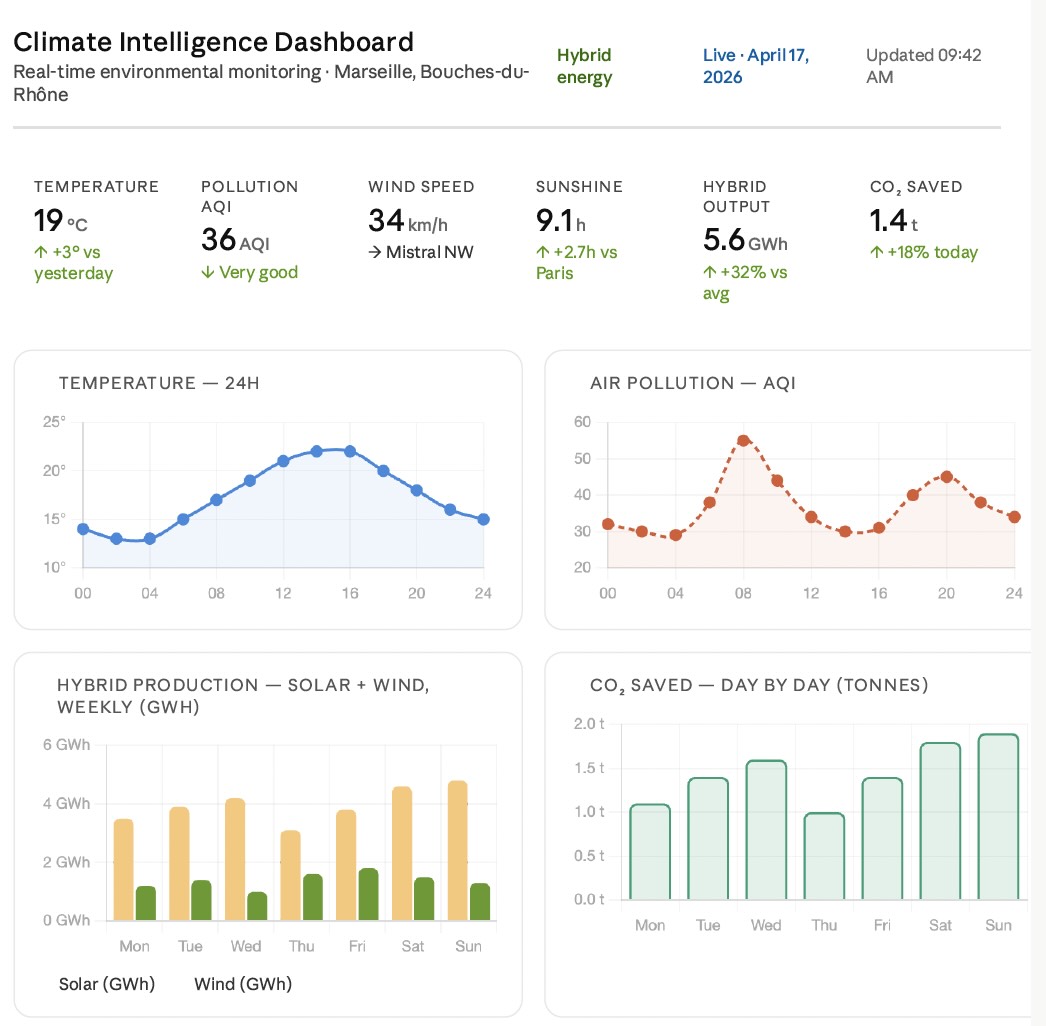
Velox does not stop at energy generation. Each deployment becomes a production asset, a real-world data node, and a climate intelligence layer — helping public institutions improve resilience, planning, and long-term asset performance.
Energy layer
Hybrid wind and solar infrastructure reduces diesel dependency, lowers exposure to grid instability, and improves local energy resilience.
Data layer
Continuous environmental and operational data creates measurable visibility across sites, districts, and territories.
Intelligence layer
Climate and operational intelligence supports better forecasting, better planning, and better infrastructure decisions over time.
Designed for exposed, strategic, and high-impact public assets
Velox is relevant wherever public infrastructure must become more resilient, more efficient, and more measurable: municipalities, transport hubs, health facilities, campuses, public utilities, and remote administrative or service sites.

Cities & districts
Support urban decarbonization, stronger local resilience, and clearer ESG visibility across public assets.
Health & education facilities
Secure continuity of service for critical public assets with local production and better infrastructure monitoring.
Remote public sites
Reduce diesel dependency and operating costs where infrastructure is fragile, exposed, or expensive to maintain.
The Velox model can support city districts seeking cleaner energy and stronger ESG visibility, public facilities requiring local resilience, and remote sites where continuity of service matters more than ever.
That creates a stronger business case for municipalities, public operators, regional agencies, utilities, transport infrastructure, and institutions responsible for strategic territorial assets.

Public infrastructure that delivers operational and financial value
The value of a Velox deployment is not limited to energy generation. It strengthens resilience, improves asset performance, and creates a better foundation for planning, budgeting, and accountability.
Lower operating costs
Reduce diesel reliance, improve local generation, and lower exposure to volatile energy prices.
Strengthen continuity
Increase resilience for critical services and strategic public assets in volatile environments.
Improve planning and accountability
Use real-world infrastructure data to support budgeting, ESG reporting, and long-term investment decisions.
Start with one pilot. Build a stronger public infrastructure model.
Velox helps public institutions launch measurable pilot deployments, validate the operating model, and scale toward a more resilient, lower-cost, data-driven infrastructure network.
Start with a targeted deployment, prove the value, and expand into a broader territorial infrastructure strategy.